

CEO Huddle: In the Moment — March 2026 MSCI
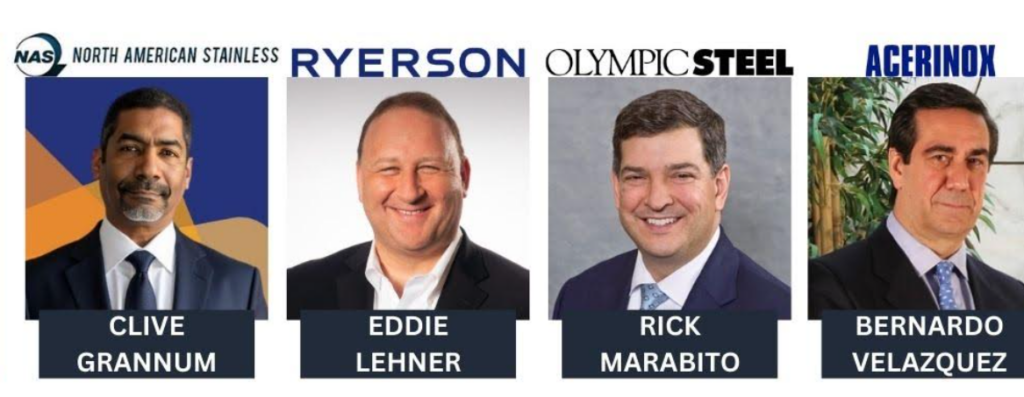
The March 2026 MSCI CEO Huddle, In the Moment, brought together some of the most respected leaders in the metals and service center industry for a forward-looking discussion on innovation, leadership, and the evolving role of technology. Featured speakers included Bernardo Velazquez, CEO of Acerinox (Spain); Clive Grannum, CEO of North American Stainless (NAS); Eddie Lehner, CEO of Ryerson and past Chair of MSCI; and Rick Marabito, President and COO of Ryerson and a past chair of MSCI.
The conversation opened with a reflection on the month of March—a time that marks the birth of some of history’s most influential minds, including Albert Einstein, Alexander Graham Bell, and Michelangelo. Each of these individuals reshaped the world through innovation, creativity, and brilliance. This naturally led to a compelling question for today’s leaders: Will the current wave of technological advancement, particularly artificial intelligence, have a comparable impact on society?
Eddie Lehner acknowledged the transformative potential of AI but offered a measured perspective. Referencing John Diebold, a pioneer in automation theory, Lehner noted that “truly transformative technologies always take longer than you might think.” His insight reinforced a key theme throughout the discussion—while innovation is inevitable, its full impact often unfolds more gradually than expected.
Rick Marabito expanded on this by emphasizing the enduring importance of the human element. As technology continues to evolve, he stressed that there is no substitute for people. Judgment, emotional intelligence, and creativity remain essential to effective leadership and decision- making. In his view, technology should enhance—not replace—the uniquely human qualities that drive progress.
Clive Grannum echoed these sentiments while adding a broader perspective. Reflecting on figures like Einstein, he noted that history’s greatest innovators created things that had never existed before. Whether artificial intelligence will achieve that same level of originality remains uncertain, but he believes it will undoubtedly be transformative. Grannum emphasized that AI is not about replacing people, but about improving efficiencies and enabling organizations to perform at a higher level. He highlighted a key distinction between traditional computing and AI—its ability to self-learn. With that capability comes both opportunity and responsibility, reinforcing the need for ethical frameworks and thoughtful implementation. Despite rapid technological progress, imagination will remain essential.
Bernardo Velazquez offered a seasoned perspective shaped by his 36 years in the industry. Reflecting on the many waves of technological change he has witnessed, he recalled that one of the most exciting innovations early in his career was the fax machine—once revolutionary, now largely obsolete. His point underscored how each era brings transformative technologies, and artificial intelligence will be one of the defining advancements of our time.
Adding a practical example, Bernardo noted how even Eddie Lehner had recognized improvements in his English with the help of AI-powered tools, illustrating how the technology is already enhancing everyday communication. He explained that AI leverages vast amounts of data and statistics to identify patterns and commonalities, generating insights at a scale previously unimaginable.
However, Bernardo emphasized that AI will not replace the brilliance of individuals like Leonardo da Vinci or Albert Einstein. Instead, he offered a compelling perspective: imagine if Einstein had access to AI—the combination of human genius and advanced technology would have sparked an even greater revolution. His message was clear—AI is a tool that amplifies human capability, not a substitute for it.
The discussion then shifted to globalization and trade policy. Rick Marabito noted that globalization is not ending, but evolving, with continued importance placed on strong relationships with Canada and Mexico. Across multiple administrations, he observed a consistent “U.S.-first” approach supporting the domestic metals industry, suggesting tariffs will remain influential.
Bernardo provided a European perspective, describing Europe as one of the largest open economies, now facing increasing pressure from imports—often from regions that do not operate under the same rules. This has led to challenges with unfair competition and a growing realization that complete dependence on external markets is not sustainable. While Europe may move slowly, he emphasized, it is beginning to adapt.
Safety was another critical focus of the discussion. At North American Stainless, the commitment to zero harm is not just a goal but a requirement. Ensuring that every employee goes home safe each day is a shared responsibility across the organization. While Anil Yadav and the safety team help lead these efforts, the culture of safety is driven by every employee.
The panel also reflected on personal growth and leadership lessons. Rick emphasized that the most valuable learning often comes from difficult moments and mistakes. Clive shared that his most impactful failures were those when he placed himself ahead of his team—experiences that reinforced the importance of humility and servant leadership.
Leadership and culture remained central themes. Bernardo reflected on his lifelong career with Acerinox, rising from a new graduate to CEO through a culture of internal development and strong values. He emphasized that leadership is about example, not authority—“You don’t need to be a killer, you need to be clever, and you need to be a leader.”
Clive reinforced this through NAS’s recognition as one of the top companies in Kentucky, attributing success to a culture built on respect—treating everyone “like a brother,” from employees to customers to the broader community.
Eddie Lehner captured this spirit by reflecting on NAS’s 35-year celebration theme: “a place to build a life—a better life.” For him, that phrase defined what strong organizations should strive to create.
Mike brought the discussion back to simplicity, emphasizing that leadership starts at the top and must be consistently demonstrated. Treat people with respect, do the right thing, and lead by example.
The conversation concluded on a personal and relatable note. When asked how his daughters might describe him, Bernardo laughed and admitted that, as teenagers, they might say he is “a dictator” who doesn’t let them do anything. But he quickly balanced that humor with sincerity, emphasizing how much he values the time he spends with his family and the importance of those moments together.
Together, the panelists offered a powerful message: while technology, policy, and strategy will continue to shape the future, it is ultimately people—guided by values, responsibility, and care for one another—who define lasting success.
